Day 1 Recap · 8 min read · Officially "Day 1 — The New Opportunity"
AI Secrets Challenge Day 1 Recap: The 7-Figure AI Shortcut
Day 1 is the mindset and the method. Russell Brunson opens with one claim — one person plus AI now does the work of a whole team — then hands you the exact shortcut that makes AI output stop sounding like AI.
The whole day rests on one idea: AI is only as good as what you feed it.
The 7-Figure AI Shortcut is three parts stacked together — Swipe File, Attractive Character, and Creative Director. Skip any one of them and your AI content reads like everyone else's.
What Day 1 actually covers
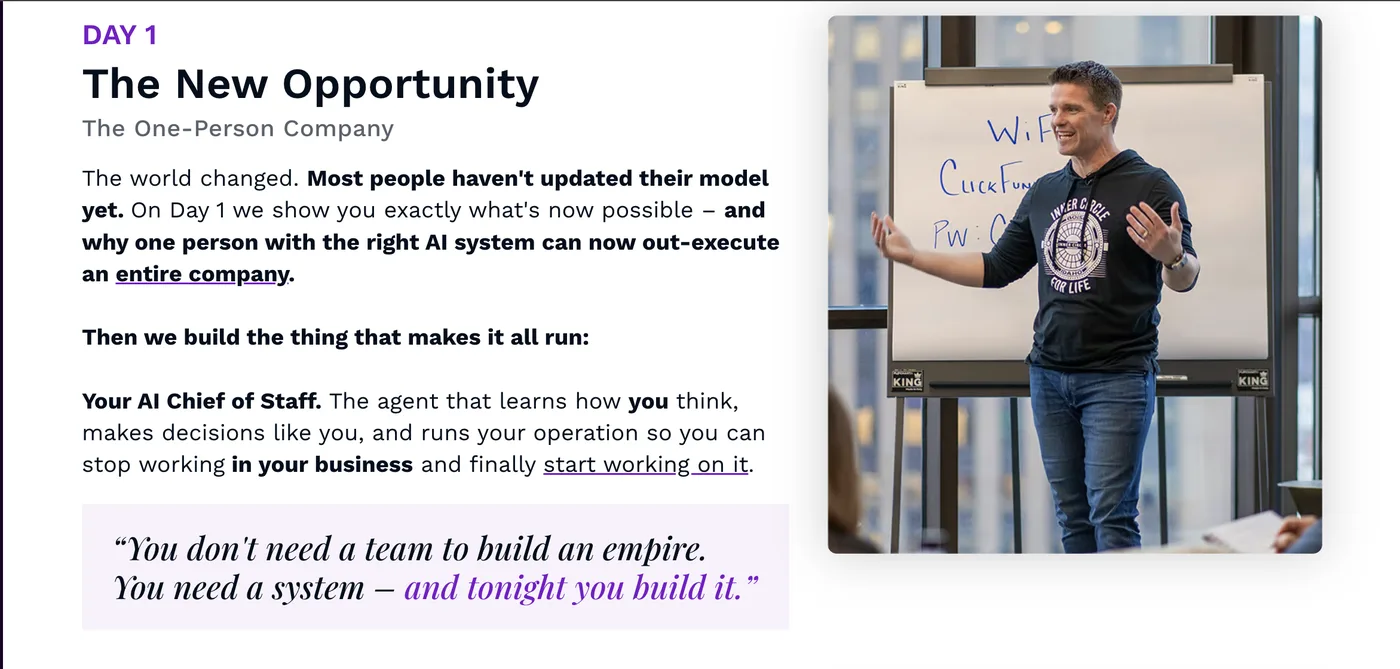
The opening thesis is blunt: the tools changed, most workflows have not, and one person with AI can now produce what used to take a full team. Russell points at Sam Altman openly predicting the first one-person billion-dollar company, then at a real example — a company (Medvynskyi) that went from founding to a $1.4B valuation in barely a year on the back of AI. He is careful to call out the parts of that story that were built unethically. The point he is making is about what is now possible, not a blueprint to copy.
Then he gets practical. The reason most people's AI output is mediocre comes down to the inputs.
The 7-Figure AI Shortcut, broken down
This is the spine of the entire challenge, so it is worth getting right:
- Swipe File — feed the AI proven, high-converting examples first (emails, VSLs, funnels that already worked) instead of letting it scour the internet for an average of everything. Russell's line for bad inputs stuck with me: "poop brownies." No matter how good the model is, garbage in is garbage out.
- Attractive Character — the human personality the audience actually connects with. Your stories, your voice, your point of view, woven into the output so it does not read like a press release.
- Creative Director — the role that pulls the stories and frameworks out of the Attractive Character and directs the AI to sound like them. This is the job almost nobody assigns, and it is why most AI content falls flat.
Why most people's AI content is garbage
They skip straight to prompting. No swipe file, no voice, no director. So the model hands back the statistical average of the internet, and it sounds like it. Day 1 reframes AI from a content vending machine into a leverage tool — but only if you build the three layers underneath it first.
Our honest take on Day 1
The swipe-file idea alone changed how we prompt. We stopped asking AI to "write me an email" and started handing it three emails that already converted and saying "in this voice, for this offer." The difference is not small. Day 1 does not make you money on its own. It sets up everything Days 2 through 5 build on.
Want to see it for yourself?
The AI Secrets Challenge has not announced another live cohort. The team behind it now runs the Side Hustle Summit, a free live event from September 6 to 13, 2026. Registration is free, no credit card required.
Reserve My Free Seat → 5 days · 90 min/day · No credit card requiredDay 1 FAQ
What is the 7-Figure AI Shortcut?
It is the three-part method Russell Brunson teaches on Day 1 of the AI Secrets Challenge: Swipe File (feed AI proven examples), Attractive Character (inject your real voice and stories), and Creative Director (direct the AI to sound like you). Together they make AI output that converts instead of reading like generic AI.
What is a swipe file in AI marketing?
A swipe file is a collection of proven, high-converting marketing assets — emails, video sales letters, funnels, ads — that you feed to the AI as examples before asking it to create. It keeps the model from producing the average of everything on the internet.
What did Russell mean by "poop brownies"?
It is his metaphor for bad inputs. A brownie made with one bad ingredient is still inedible no matter how good the rest is. Feed AI weak examples and you get weak output, regardless of how powerful the model is.
Is Day 1 worth attending if I already use ChatGPT?
Yes. Most ChatGPT users skip the swipe file and the voice layer entirely, which is exactly why their output is generic. Day 1 is about the inputs and the system around the model, not the model itself.